
Y tho? Why it is now time for new management methods
I would like to put a short spotlight on an aspect that shows why the content of this blog is more relevant than ever and which questions arise for modern managers.
The world is changing
One might think that for modern companies, the human factor loses competitiveness due to the growing intelligence of computers. But can the success of Apple, Google, Airbnb or Uber be explained by the clever use of technology?
The so-called Taylor bathtub shows this misconception impressively:
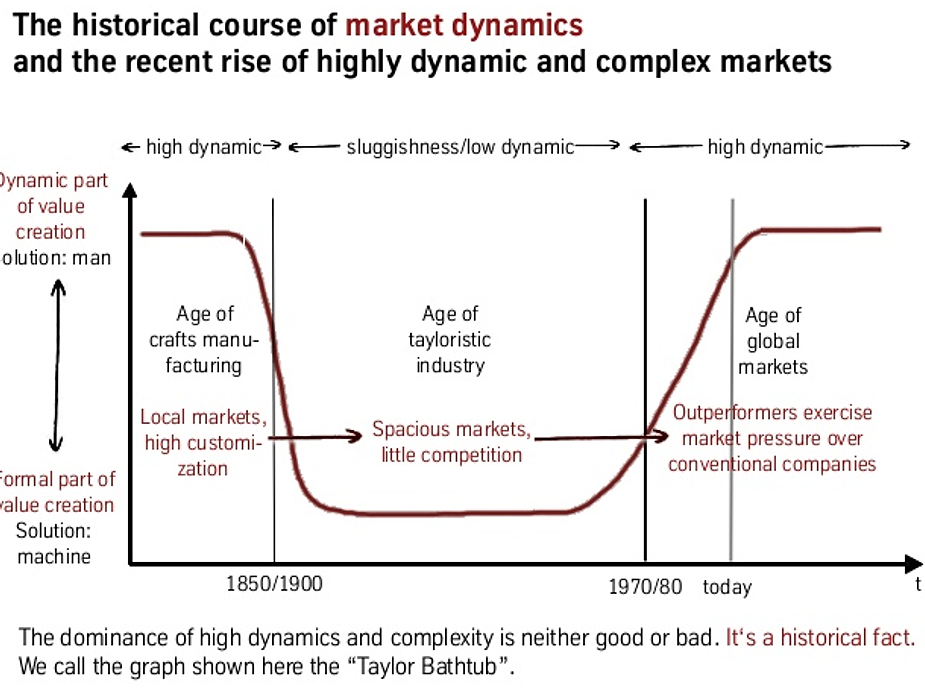
The Taylor bathtub explains how globalization initially established methods and technology as a competitive advantage to fill market gaps. However, the opening up of these markets means that causal shares lose their relevance again. The true differentiation takes place increasingly through people.
Before the invention of the conveyor belt, the entrepreneur who had the most mastered his trade, had great ideas and was able to react flexibly to changes in the market (e.g. with one-off productions). These factories were often protected locally, i.e. they often only had competitors with very similar conditions. A blacksmith from the Neckar valley did not have to fear a blacksmith in the Rhine valley and he would not have had any competitive advantage over this other market if he could have delivered a much better product. Even if products were so good that everyone wanted to have them, the time-consuming handicraft component limited it so that you could leave your local market easily and profitably.
The manufacturing age ended with the introduction of assembly line production in 1910. Suddenly the company was the front-runner, which managed to reduce costs, minimize waste or automate production steps. Much of the increase in productivity came from the specialization of the workforce. Processes were defined, rules were introduced and workflows were optimized in such a way that man and machine created products almost perfectly at the same time. The competitive advantage in a globalizing world was mainly technological or methodological in nature. In this period of Taylorism, man was often left behind.
The crux of modern management theory is that many decision-makers have not yet understood that this phase has ended. Efficiency pressure is increasingly giving way to the pressure to innovate, mainly due to the increasing density of global markets. What does that mean? It is no coincidence that, for the first time since the 1910s, the average number of car manufacturers is increasing again. Should companies not be deterred from entering this market due to the technical maturity of existing market participants? Even though autonomous driving and electromobility open up new playing fields, the state of the art no longer seems to represent an inaccessible platform that protects the traditional manufacturers of elevators. Technique has thus become copyable, as shown in Trust Economy. Differentiation occurs primarily with the human factor.
The model contradicts the generally accepted assumption that in times of digitalisation the most important front is technological. A closer look reveals that many of these technologies focus on people: Collaboration platforms, communication channels and knowledge management are the bestsellers.
People change: Generation Y
Fortunately, not only the economic framework conditions are changing, but also people in general. There are many contradictory and often false statements about the so-called Generation Y. The cause and effect are often mistaken for each other: the dwindling interest in private homes is just as much connected with the associated increase in costs as with new working and living models. My assessment of this generation (which I also belong to) is a life direction, which gives great importance to self-realization, belonging, sense, fun and family. And so it is a good thing that the network economy offers and demands exactly these values. Creativity (see blog article) thrives on enough freedom, affiliation requires trust (see blog article on it) and meaningfulness in action requires insights into the effect (see blog article on reversal of hierarchy pyramid).
The business world must also change!
The environment requires it and people want it. But what about employers? I wouldn't write here if there wasn't a lot of work to do!
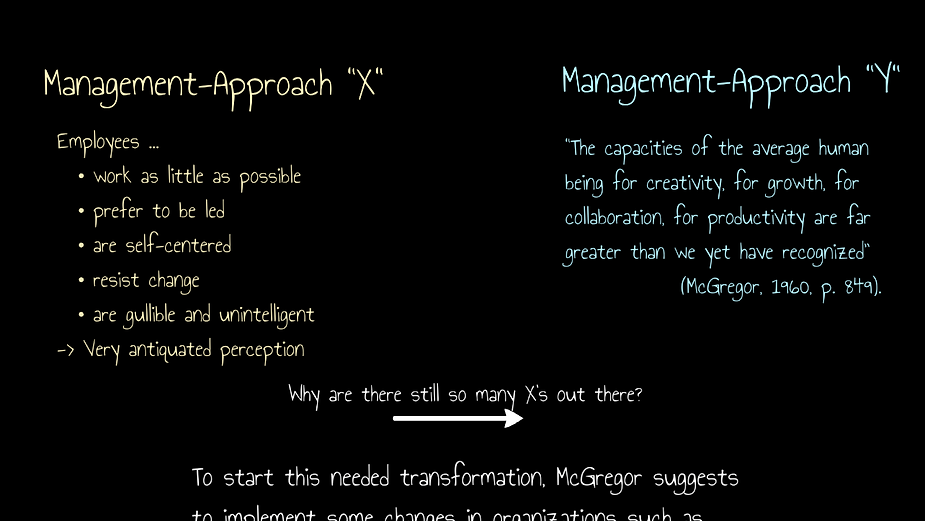
Although the organizational behavior expert Douglas McGregor (MIT Sloan School of Management) predicted this development as early as 1960 by describing the sick old world (Theory X) and the new ideal world (Theory Y, eponym for the generation of the same name), in many companies and minds still the theory X prevails. By the way, he had chosen the name theory X and Y in such a way that they were as meaningless as possible.
This makes it all the more gratifying that, especially in software development, there has been a trend for years now that holds out the hope of a Y-world. Agile methods such as scrum are centred around participation, empowerment and decentralization and are thus a first widespread implementation of these theories.
Microsoft(opens in a new tab) went even a little further and tried out in several projects what would still be possible with modern management methods.
However, it is not only activities at the working level that are decentralised, but also knowledge of business decisions: One of the needs of the new generation, which is now recognized in many companies, is the meaningfulness of one's own work. In order to satisfy this need, a rethinking of corporate communications has just taken place. Simon Sinek, the father of this rethinking explains in his book Start with why(opens in a new tab), why it is so important today to explain the why to all those involved. It even clearly shows why Apple is so successful in its marketing, even though the technology rarely or only briefly surpasses that of the competition.
People don't buy what you do, they buy why you do it.
Simon Sinek
And that brings us full circle. Apple is so successful because it emphasizes the Ys (generation and theory) and the why.
McGregor already recognized that Theory X companies are also very successful (even on average more successful). However, my claim for modern management is to focus on people, which not only aims at profit, but also at the well-being of all stakeholders.
Until this has been achieved, I will have plenty of time to write and fortunately, there are also plenty of things to write about here!
Thus, the questions that are raised, among other things, are:
- How do you manage to empower people to reach their full development potential?
- How can companies identify and respond to future challenges?
- How do you manage to organize companies in such a way that the environment for such employees is in place to be able to solve these problems?
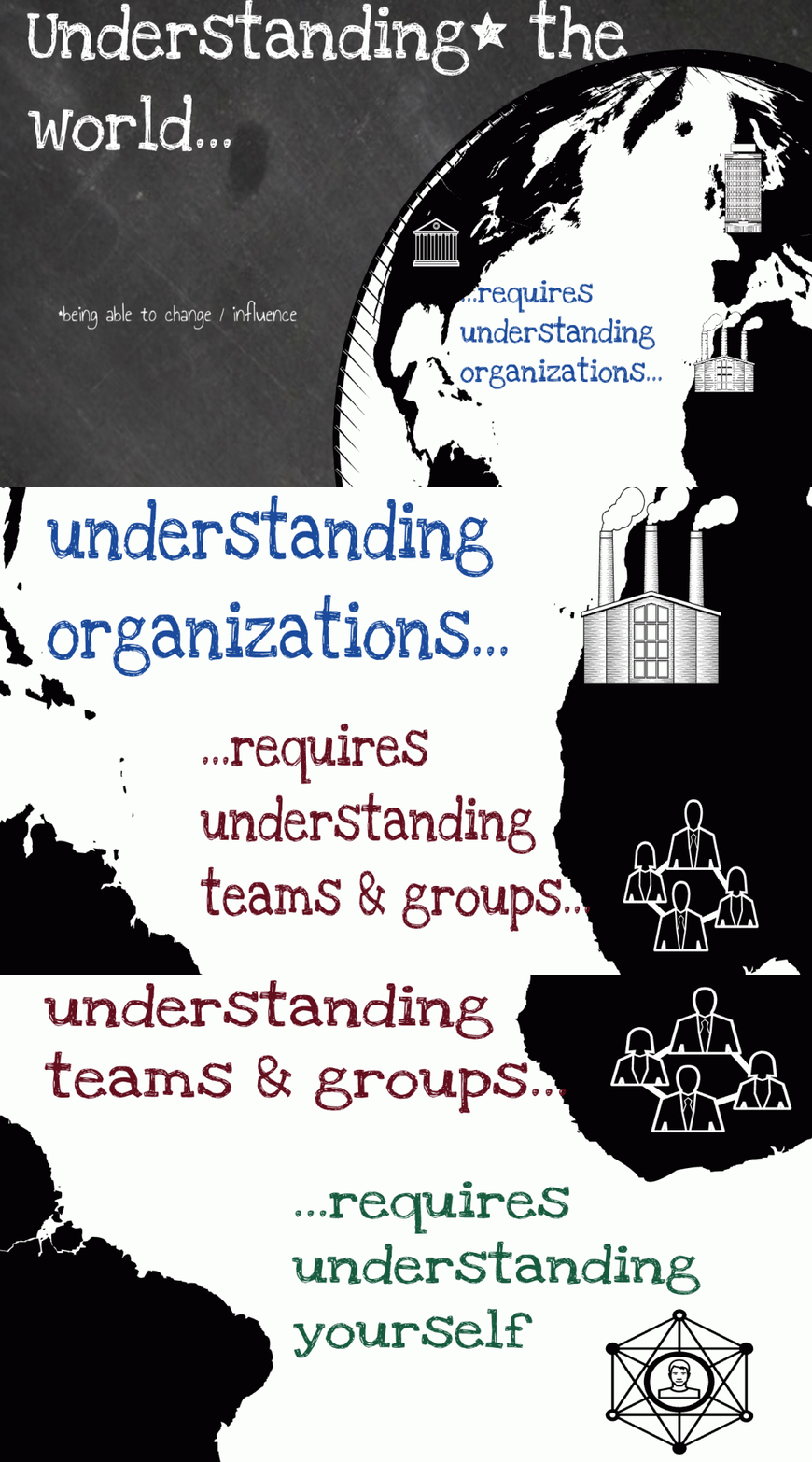
According to the approach of my former professor Kenneth Murrell, all articles are assigned to at least one category. These are:
- Understanding yourself and others
- Understanding teams
- Understanding Organizations
All three categories build on each other. Only those who have understood each other can understand others. Understanding others means understanding group processes. Understanding group processes means understanding organizational processes. And last but not least, because the world consists of organizations (religions, states, companies): Understanding organizational processes means understanding the world.
About the Author

Kevin Rassner is an expert in applied organizational development, supporting companies through transformation processes that span strategy, leadership, and culture. He combines over ten years of leadership experience with a systemic perspective on effective collaboration.
About the Author
Kevin Rassner is an expert in applied organizational development, supporting companies through transformation processes that span strategy, leadership, and culture. He combines over ten years of leadership experience with a systemic perspective on effective collaboration.